
AI in Scan to BIM: Automating Point Cloud to Revit Workflows
Scan to BIM is one of the areas experiencing significant transformation. Traditionally, converting laser-scanned point clouds into intelligent BIM models required substantial manual modeling, interpretation, and quality checking. Today, Artificial Intelligence (AI), machine learning, computer vision, and automated recognition technologies are helping BIM professionals accelerate this process.
AI-powered Scan to BIM workflows can assist in identifying building elements from point clouds, recognizing geometric patterns, extracting information, and supporting the creation of accurate Revit models. While human expertise remains essential for validation and modeling decisions, AI can significantly reduce repetitive work and improve workflow efficiency.
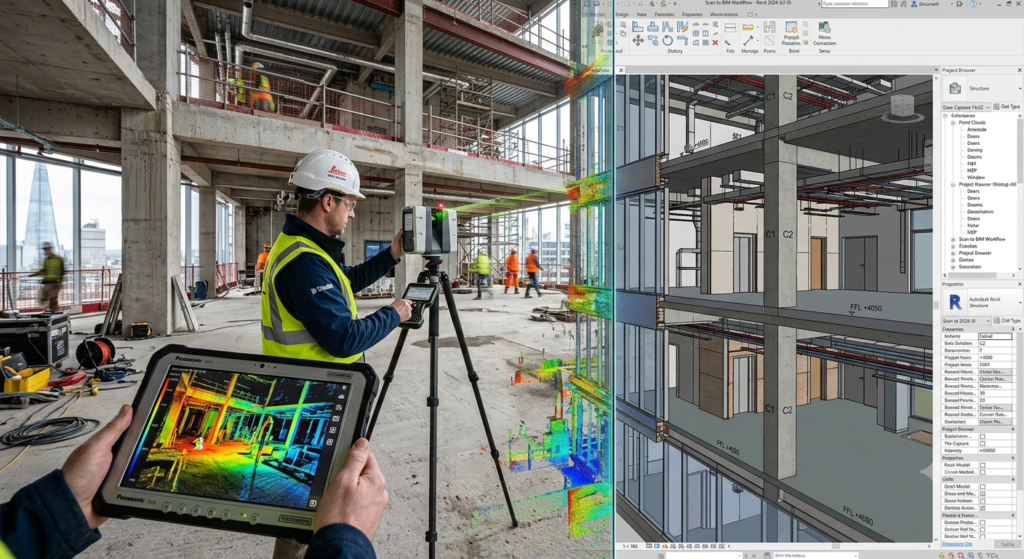
What Is Scan to BIM?
Scan to BIM is the process of converting reality-capture data—such as laser scans, LiDAR scans, and point clouds—into a structured Building Information Model.
A typical workflow involves:
Existing Building → Laser Scanning → Point Cloud → Point Cloud Processing → Element Recognition → Revit Modeling → BIM Validation
Point clouds contain millions or billions of individual points representing the geometry of an existing building. These points can capture walls, floors, ceilings, columns, beams, pipes, ducts, equipment, doors, windows, and other physical elements.
How AI Is Changing Scan to BIM
Traditional Scan to BIM workflows often depend heavily on manual interpretation. BIM modelers examine the point cloud and identify individual elements before recreating them in Revit.
AI introduces automation into several stages of this workflow.
1. Automated Point Cloud Classification
AI and machine-learning algorithms can help classify point-cloud data into categories such as:
- Walls
- Floors
- Ceilings
- Columns
- Beams
- Doors and windows
- Pipes
- HVAC components
- Electrical elements
- Structural components
Instead of manually inspecting every area of a point cloud, automated classification can help BIM teams identify likely building components faster.
2. Object Recognition
One of the most valuable applications of AI is object recognition.
Computer-vision and machine-learning techniques can analyze geometric characteristics and patterns within point clouds to identify objects.
For example, an algorithm may recognize:
- A vertical planar surface as a potential wall
- Repeated cylindrical geometry as piping
- Rectangular overhead geometry as ductwork
- Repeated structural geometry as columns or beams
The recognized information can then support downstream BIM modeling.
3. Automated Geometry Extraction
AI can help identify geometric boundaries and relationships within point-cloud data.
For example, it can assist with determining:
- Wall locations
- Floor elevations
- Ceiling heights
- Column positions
- Pipe centerlines
- Duct dimensions
- Opening locations
This can reduce the amount of repetitive measurement and interpretation required from BIM modelers.
Benefits of AI-Powered Scan to BIM
Faster Modeling
AI can automate repetitive recognition and interpretation tasks, allowing BIM teams to focus more on complex modeling and validation.
Improved Productivity
Automated workflows can reduce the amount of manual point-cloud inspection required, particularly on large buildings and infrastructure projects.
Better Data Processing
Large point-cloud datasets can contain enormous amounts of information. AI can help organize and classify this information more efficiently.
Reduced Manual Errors
Automation can reduce certain repetitive human errors associated with manually identifying and measuring large numbers of building elements.
Improved Existing-Building Documentation
AI-assisted Scan to BIM can help organizations create accurate digital representations of existing buildings for renovation, refurbishment, retrofit, and facility management projects.
Better BIM Coordination
Once point-cloud information is converted into structured BIM elements, architectural, structural, and MEP teams can use the model for coordination and design development.
Conclusion
AI in Scan to BIM is transforming how existing buildings are converted into intelligent digital models. By combining point-cloud processing, computer vision, machine learning, automation, and Revit-based BIM modeling, AEC companies can create more efficient workflows for existing-condition documentation.
However, AI should be viewed as an augmentation technology rather than a complete replacement for BIM expertise. The strongest results come from combining automated recognition with experienced BIM modelers, rigorous quality control, and clearly defined project requirements.
Frequently Asked Questions
1. What is AI in Scan to BIM?
AI in Scan to BIM uses machine learning, computer vision, and automation techniques to assist in identifying and processing building elements from point-cloud data and converting that information into BIM models.
2. Can AI automatically convert a point cloud into a Revit model?
AI can automate or assist with portions of the conversion process, but complete automation is not reliable for every project. Human BIM professionals are still required for validation, modeling decisions, LOD compliance, and quality control.
3. What types of elements can AI recognize from point clouds?
Depending on the technology and dataset, AI can assist in recognizing walls, floors, ceilings, columns, beams, pipes, ducts, doors, windows, and other building components.
4. Is AI useful for MEP Scan to BIM?
Yes. AI-assisted recognition can help identify MEP components such as pipes, ducts, and equipment, although complex MEP environments require careful professional validation.
5. What software is used in Scan to BIM workflows?
Depending on the project, workflows may involve point-cloud processing software, reality-capture platforms, Revit, and specialized AI or automation technologies.
6. What are the main benefits of AI-powered Scan to BIM?
The main benefits include faster processing, reduced repetitive work, improved productivity, better point-cloud organization, and support for creating accurate existing-condition BIM models.
7. Does AI replace Scan to BIM modelers?
No. AI can automate repetitive tasks, but experienced BIM professionals remain important for interpretation, modeling standards, accuracy verification, coordination, and quality assurance.
Contact Us
Phone : +91 70301 51694
E-mail: contact@matrix-designs.com