
BIM & Cloud Collaboration: How Modern Teams Manage Construction Projects
There is an ongoing trend towards digitization in the construction industry. This involves using BIM (Building Information Modeling) along with cloud-based collaboration to transform how architects, engineers, contractors, and all parties involved interact during the course of a project.
In traditional construction projects, there is usually dependence on drawing, emails, spreadsheets and local file storage. This can lead to outdated data, coordination problems, wastage of time and rework.
Using BIM and cloud collaboration tools will enable teams to work within one integrated environment and have access to the latest information related to the project and coordinate models, among others.
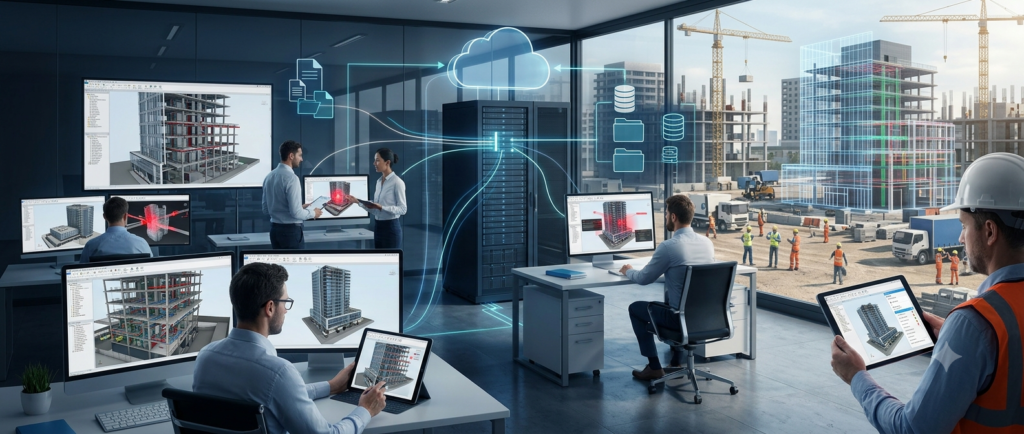
What Is BIM + Cloud Collaboration?
BIM is a digital process for creating and managing information about a building or infrastructure project throughout its lifecycle. A BIM model can contain geometry, materials, specifications, quantities, systems information, and other project data.
Cloud collaboration allows project information, models, documents, issues, and project communications to be accessed and managed through cloud-based platforms.
When these technologies are combined, project stakeholders can collaborate around a shared digital project environment instead of relying on isolated files.
For example, an architect can update a design model while structural and MEP teams coordinate their work using the latest information. Contractors can review models and documentation from the field, while project managers can track issues and approvals.
Why Is Cloud Collaboration Important for Construction?
Construction projects require several stakeholders to work from various locations. For instance, architects could be working from one office, structural engineers from another office, MEP consultants from a different place, and contractors could be working from the site itself.
Information management among these teams might be difficult.
Cloud collaboration assists in establishing a centralized platform for teams to:
Have access to the most updated information about the project
Exchange BIM models and drawings
Coordinate various disciplines
Document project problems
Manage document revisions
Facilitate project change communication
Review models virtually
Increase project transparency
How BIM and Cloud Collaboration Work Together
The real value comes from combining BIM’s structured project information with cloud-based accessibility.
A typical workflow can include:
1. BIM Model Creation
Architectural, structural, MEP, and other discipline-specific models are developed using BIM software.
Each model contains relevant geometric and non-geometric information required for project coordination and documentation.
2. Cloud-Based Model Sharing
Models and project documents can be uploaded to a centralized cloud environment.
Authorized team members can access project information without depending entirely on local file storage.
3. Multidisciplinary Coordination
Architectural, structural, and MEP models can be coordinated to identify potential conflicts.
For example:
- HVAC ducts conflicting with structural beams
- Plumbing pipes passing through structural elements
- Electrical services conflicting with ceilings
- Equipment requiring more space than originally planned
These issues can be identified before they create problems during construction.
4. Issue Tracking
When a coordination problem is identified, teams can create an issue and assign it to the responsible person or discipline.
Issues can include:
- Location
- Description
- Priority
- Responsible team
- Status
- Supporting documentation
This creates a more structured approach to resolving project problems.
5. Real-Time Communication
Instead of relying exclusively on long email chains, project teams can communicate around specific models, drawings, documents, and issues.
This provides better context and helps reduce misunderstandings.
6. Construction Site Access
Cloud-based BIM environments can allow field teams to access relevant project information from mobile devices.
Site personnel can review drawings, models, specifications, and project issues while working on-site, subject to the project’s platform and permissions.
Key Benefits of BIM + Cloud Collaboration
1. Centralized Project Information
One of the biggest advantages is having project information organized within a centralized environment.
Teams can manage:
- BIM models
- 2D drawings
- Specifications
- Documents
- Issues
- Project communications
- Revisions
This can reduce dependence on scattered files and disconnected communication channels.
2. Improved Team Coordination
BIM provides a common digital representation of the project, while cloud collaboration makes that information easier for distributed teams to access.
This improves coordination between:
Architectural + Structural + MEP + Contractor + Client
Better coordination can reduce the risk of design conflicts reaching the construction site.
3. Faster Clash Detection
BIM coordination allows teams to identify clashes between building systems before installation.
For example, an MEP duct may intersect with a structural beam.
Finding the issue during construction can result in:
- Rework
- Additional labor
- Material wastage
- Schedule disruption
Identifying the problem during the coordination stage provides an opportunity to resolve it earlier.
4. Better Version Control
Construction projects can generate thousands of drawings and documents.
Without proper version control, teams may accidentally use outdated information.
Cloud-based document management can help teams identify current and previous versions and maintain a more controlled information workflow.
5. Remote Collaboration
Modern construction teams are often geographically distributed.
Cloud collaboration enables stakeholders to review and coordinate project information without always being physically present in the same office.
This is particularly valuable for international BIM projects and outsourced BIM workflows.
6. Faster Decision-Making
When project information is accessible and coordinated, stakeholders can make decisions using more current information.
For example, project teams can review a model, investigate an issue, communicate with the responsible discipline, and track its resolution within a connected workflow.
7. Reduced Rework
Poor coordination is a major source of construction rework.
BIM-based coordination can help identify design and system conflicts before construction.
The earlier a problem is discovered, the easier and generally less expensive it is to address.
8. Better Project Transparency
Cloud collaboration creates greater visibility into project information and issue status.
Project managers can monitor:
- Open issues
- Resolved issues
- Pending approvals
- Model updates
- Document revisions
- Coordination progress
This supports more informed project management.
The Future of BIM and Cloud Collaboration
The future of construction is moving toward increasingly connected digital environments.
BIM and cloud collaboration are likely to become more closely integrated with:
- Artificial intelligence
- Digital twins
- Automated clash detection
- Construction analytics
- Reality capture
- 4D construction planning
- 5D cost management
- IoT and connected job sites
- Mobile field technologies
Conclusion
BIM + Cloud Collaboration is transforming how modern construction teams create, share, coordinate, and manage project information.
BIM provides the structured digital model, while cloud collaboration provides a connected environment for teams to access and manage that information.
Together, they can improve:
- Collaboration
- Coordination
- Document management
- Clash detection
- Version control
- Remote working
- Issue tracking
- Project transparency
- Construction efficiency
Frequently Asked Questions
1.What is BIM cloud collaboration?
BIM cloud collaboration combines Building Information Modeling with cloud-based platforms so project teams can access, share, coordinate, and manage BIM models and project information from a centralized environment.
2. What are the benefits of BIM and cloud collaboration?
Key benefits include improved coordination, centralized information, better version control, remote collaboration, faster issue resolution, improved communication, and reduced risk of construction rework.
3.How does cloud collaboration improve BIM coordination?
Cloud collaboration allows multidisciplinary teams to access current models, review coordination issues, communicate about problems, and track issue resolution through a connected workflow.
4. Is BIM cloud collaboration suitable for international projects?
Yes. Cloud-based BIM workflows are particularly useful for geographically distributed teams because stakeholders can collaborate on project information without needing to work from the same physical location.
5. What is a Common Data Environment in BIM?
A Common Data Environment (CDE) is a structured environment used to collect, manage, share, and control project information throughout a project lifecycle.
6.Can BIM cloud collaboration reduce construction costs?
It can help reduce costs indirectly by improving coordination, identifying conflicts earlier, reducing information errors, and minimizing certain types of rework and construction delays.
7. What BIM services can be integrated with cloud collaboration?
Common services include BIM modeling, architectural BIM, structural BIM, MEP BIM, BIM coordination, clash detection, Scan to BIM, BIM quantification, 4D BIM, and 5D BIM.
Contact Us
Phone : +91 70301 51694
E-mail : contact@matrix-designs.com