
BIM Beyond 3D: Why BIM Information Management Matters in Construction
Building Information Modeling (BIM) is often associated with 3D digital models, but the real value of BIM goes far beyond geometry and visualization. A BIM model becomes truly powerful when it contains accurate, structured, and accessible information that supports decisions throughout the project lifecycle.
From design and coordination to construction and facility management, BIM information management helps project teams use the right data at the right time. This can improve collaboration, reduce errors, control costs, and support better project outcomes.
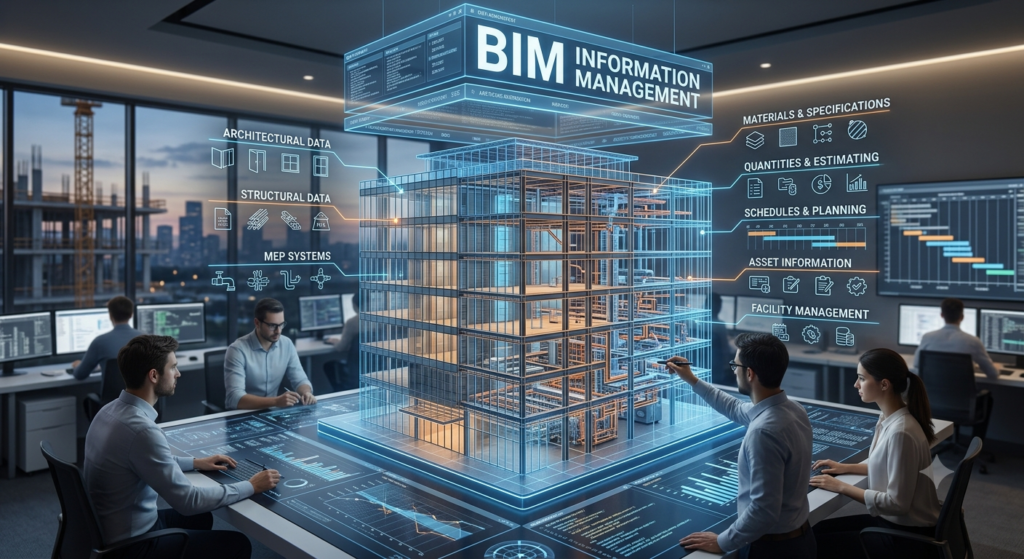
What Is BIM Information Management?
BIM information management is the process of creating, organizing, sharing, checking, and maintaining project information throughout the BIM lifecycle.
This information can include:
- Building element specifications
- Material and product data
- Dimensions and quantities
- Equipment information
- Asset identification
- Installation requirements
- Cost information
- Construction schedules
- Maintenance data
- Project documentation
BIM Beyond 3D: The Dimensions of BIM
The concept of BIM has expanded beyond traditional 3D modeling.
3D BIM – Geometry and Design
3D BIM represents the physical and spatial characteristics of a project.
It helps teams understand:
- Building geometry
- Architectural elements
- Structural systems
- MEP systems
- Spatial relationships
- Design coordination
Tools such as Revit, Archicad, and other BIM platforms can be used to create information-rich models.
4D BIM – Time and Construction Planning
4D BIM connects the model with time and scheduling information.
Construction teams can link model elements to activities in a project schedule and visualize the sequence of construction.
This can help with:
- Construction sequencing
- Site planning
- Schedule visualization
- Progress monitoring
- Identifying potential scheduling conflicts
5D BIM – Cost and Quantity Information
5D BIM connects BIM data with quantities and cost information.
Teams can extract quantities from models and use them to support cost estimation and budgeting.
This can improve:
- Quantity takeoffs
- Cost planning
- Budget monitoring
- Change management
- Procurement planning
6D and 7D BIM – Sustainability and Facility Management
Depending on the project’s BIM standards and terminology, additional dimensions can incorporate sustainability, energy performance, asset management, and facility management information.
How BIM Information Management Improves Construction
1. Better Coordination
Construction projects involve architects, structural engineers, MEP consultants, contractors, fabricators, and other stakeholders.
When everyone works with reliable information, coordination becomes easier.
For example, MEP teams can coordinate equipment and services with architectural and structural elements before construction begins.
This helps identify issues such as:
Duct and beam clashes
Pipe and structural conflicts
Cable tray interference
Equipment access problems
Insufficient maintenance space
2. Reduced Rework
Poor information can lead to incorrect fabrication, installation, and construction decisions.
When project information is properly structured and coordinated, teams can identify many problems during the design and coordination stages rather than on site.
The result can be less rework, fewer errors, and better construction efficiency.
3. Improved Quantity Takeoffs
A properly developed BIM model contains data about building components.
This allows teams to extract quantities more efficiently for:
Concrete
Steel
Doors and windows
Finishes
Pipes
Ductwork
Cable trays
Equipment
Accurate model information can therefore support estimating and procurement workflows.
4. Better Decision-Making
BIM information gives project stakeholders a clearer understanding of the project.
Instead of relying only on drawings, teams can analyze model-based information to make decisions related to design, cost, schedule, construction, and asset management.
5. Improved Collaboration
One of the biggest advantages of BIM is that it creates a common digital environment where project information can be coordinated and shared.
With appropriate information-management processes, teams can work with:
Current models
Approved documents
Revision information
Coordination issues
Project data
Asset information
Common BIM Information Management Challenges
Despite its benefits, managing BIM information can be challenging.
Inconsistent Data
Different teams may use different naming conventions, parameters, classification systems, or data structures.
Poor Model Standards
Without clear BIM standards, models can become inconsistent and difficult to use.
Outdated Information
If models and documents are not regularly updated, teams may make decisions using outdated information.
Lack of Collaboration
BIM requires collaboration between multiple disciplines. Poor communication can reduce the value of even a technically advanced model.
Unclear Information Requirements
Project teams should understand what information is required, who is responsible for creating it, when it is needed, and how it should be delivered.
The Role of a Common Data Environment
A Common Data Environment (CDE) provides a structured environment for managing and sharing project information.
A well-managed CDE can help teams control:
- Project documents
- BIM models
- Revisions
- Approvals
- Issue information
- Project deliverables
The objective is not simply to store files. It is to make sure that project information is organized, accessible, traceable, and controlled.
Conclusion
BIM Beyond 3D: Why Information Management Matters in Construction is ultimately about understanding what makes BIM different from traditional 3D modeling.
The geometry of a model tells us what something looks like and where it is. The information tells us what it is, what it does, how much it costs, when it should be installed, and how it should be maintained.
Frequently Asked Questions
What is BIM information management?
BIM information management is the process of creating, organizing, exchanging, checking, and maintaining project information throughout the BIM lifecycle.Is BIM only a 3D model?
No. 3D modeling is one component of BIM. BIM also involves structured information related to design, construction, cost, schedule, assets, and operations.- How does BIM information management reduce construction errors?
Accurate and coordinated information helps project teams identify design conflicts, inconsistencies, and missing information before they create problems during construction. - What is the difference between BIM modeling and BIM information management?
BIM modeling focuses primarily on creating digital representations of building elements, while information management focuses on ensuring that the data associated with those elements is accurate, structured, accessible, and useful. - Why is BIM data important after construction?
BIM data can support facility management, maintenance, asset tracking, space management, renovations, and future operational decisions.
Contact Us
Phone: +91 70301 51694
E-mail: contact@matrix-designs.com