
How BIM Services Are Transforming the Construction Industry in 2026
What Are BIM Services?
BIM services involve the creation, management, coordination, and utilization of digital building information throughout the project lifecycle.
Unlike traditional CAD drawings, BIM models contain both geometric information and project data. This allows project teams to use a coordinated digital model for design development, analysis, construction, quantity estimation, facility management, and decision-making.
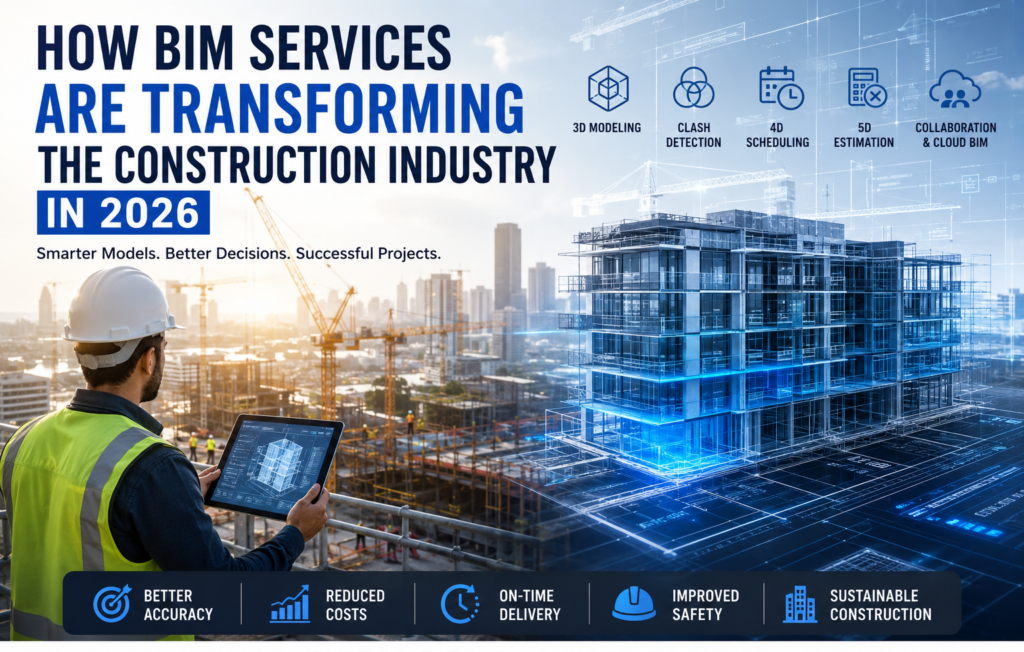
1. BIM Is Improving Design Accuracy
Traditional 2D workflows often require teams to coordinate information across multiple drawings and disciplines. BIM brings architectural, structural, mechanical, electrical, and plumbing information into a coordinated digital environment.
Design teams can identify inconsistencies earlier and make changes before construction begins.
2. Clash Detection Is Reducing Construction Problems
In complex construction projects, multiple systems must occupy the same physical space. A duct may conflict with a structural beam, a pipe may interfere with a cable tray, or equipment may clash with architectural elements.
BIM coordination software allows teams to identify these conflicts before they become problems on site.
3. 4D BIM Is Improving Construction Planning
BIM is increasingly being integrated with project schedules to create 4D BIM workflows.
4D BIM connects the 3D model with time-related information. Project teams can visualize how the building will be constructed over time.
4. 5D BIM Is Improving Cost Management
Another major development is the integration of BIM with cost estimation.
5D BIM connects model elements with quantities and cost information. When model elements are modified, quantities can be updated more efficiently, helping teams maintain better cost visibility.
Why Construction Companies Are Investing in BIM Services
The construction industry is becoming increasingly complex. Projects are larger, stakeholders are more distributed, building systems are more sophisticated, and clients expect greater transparency.
BIM services help organizations address these challenges by creating a single, coordinated source of project information.
The value of BIM is therefore not simply the creation of a 3D model. Its real value comes from using structured project information to improve decision-making throughout the project lifecycle.
Key Benefits of BIM Services in 2026
For construction companies, the major benefits of BIM services include:
- Better Coordination: Multiple disciplines can work with coordinated information.
- Reduced Errors: Design conflicts can be identified before construction.
- Improved Cost Control: Model-based quantities can support more accurate estimates.
- Faster Construction Planning: 4D BIM can connect models with project schedules.
- Better Visualization: Stakeholders can understand complex designs more easily.
- Reduced Rework: Problems can be addressed during the design and coordination stages.
- Improved Collaboration: Project teams can share structured information more effectively.
- Lifecycle Value: BIM information can continue to support facility operations after construction.
The Future of BIM in Construction
The future of BIM is moving beyond traditional 3D modeling.
The construction ecosystem is increasingly moving toward connected digital workflows involving:
- BIM
- Cloud collaboration
- AI
- Digital twins
- IoT
- Reality capture
- 4D and 5D modeling
- Automation
- Data analytics
This evolution will make BIM an increasingly important component of digital construction and asset management.
Companies that integrate BIM strategically into their workflows can improve project visibility, coordination, and decision-making while creating a stronger foundation for digital transformation.
Conclusion
Frequently Asked Questions (FAQs)
1. How is BIM transforming the construction industry in 2026?
BIM is improving construction through better design coordination, clash detection, quantity estimation, 4D scheduling, 5D cost management, prefabrication, Scan to BIM, and cloud-based collaboration.
2. What are the main benefits of BIM services?
Key benefits include improved design accuracy, reduced rework, better coordination, accurate quantity takeoffs, improved construction planning, cost control, and better communication between project stakeholders.
3. How does BIM reduce construction errors?
BIM allows architects, structural engineers, and MEP teams to coordinate their designs in a shared digital model. Potential clashes and design inconsistencies can be identified and resolved before construction begins.
4. What is BIM clash detection?
BIM clash detection is the process of identifying conflicts between different building systems, such as structural elements, ducts, pipes, cable trays, and architectural components, before they create problems on site.
5. What is the difference between 4D BIM and 5D BIM?
4D BIM connects the 3D model with project scheduling and construction timelines. 5D BIM adds cost and quantity information, helping teams manage estimates, budgets, and project costs.
6. Can BIM services help reduce project costs?
Yes. BIM can help reduce costs by identifying clashes early, improving quantity estimation, minimizing rework, optimizing construction sequences, and supporting better material and resource planning.
7. What is Scan to BIM?
Scan to BIM converts laser-scanned or reality-capture data of an existing building into a digital BIM model. It is particularly useful for renovation, retrofit, refurbishment, and as-built documentation projects.
9. Can BIM be used for prefabrication and modular construction?
Yes. BIM provides detailed and coordinated information that can support the fabrication and assembly of precast, steel, rebar, MEP, modular, and LGSF components.
10. Is BIM useful for existing buildings?
Yes. BIM can be used for existing-condition documentation, renovation planning, facility management, retrofit projects, and building upgrades through workflows such as Scan to BIM.
Contact Us
+91 70301 51694
contact@matrix-designs.com