
AI-Powered BIM Coordination: Faster Clash Detection and Project Decisions
Building Information Modeling (BIM) has transformed how architects, engineers, contractors, and construction teams coordinate projects. However, as projects become larger and more complex, manually reviewing models, identifying clashes, and coordinating design changes can become time-consuming.
This is where Artificial Intelligence (AI) and BIM coordination are creating new opportunities.
AI-powered BIM coordination can help project teams analyze large amounts of model data, identify potential conflicts earlier, prioritize coordination issues, and support faster project decisions. Instead of relying entirely on manual model reviews, teams can combine BIM workflows with AI-assisted analysis and automation to improve coordination efficiency.
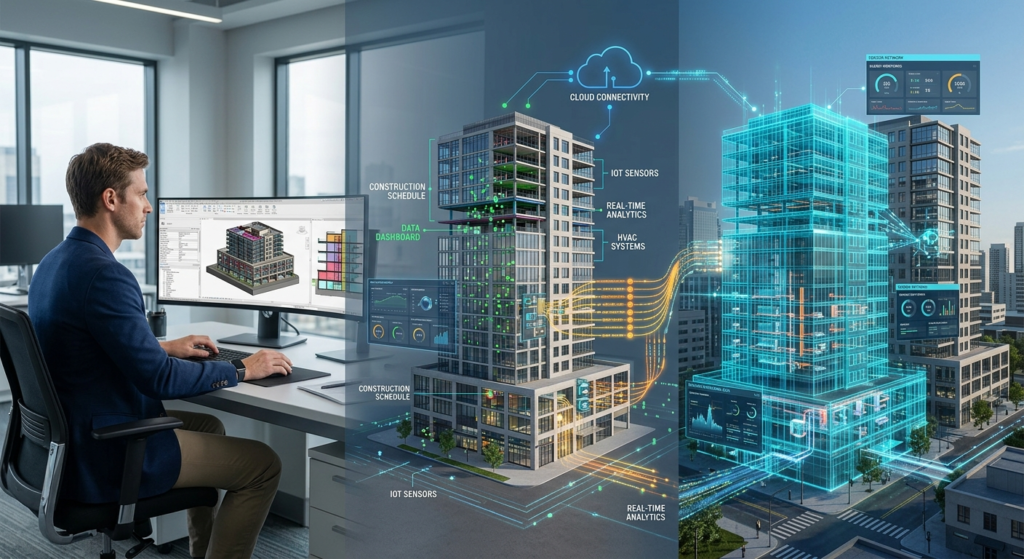
What Is AI-Powered BIM Coordination?
AI-powered BIM coordination combines BIM models, rule-based analysis, machine learning, automation, and project data to improve the coordination process.
Traditional BIM coordination typically involves creating discipline-specific models, combining them into a federated model, running clash detection, reviewing clashes, assigning issues, and coordinating revisions.
AI can enhance these processes by helping teams:
- Identify potential clashes and coordination problems
- Classify and prioritize detected issues
- Recognize recurring coordination patterns
- Analyze large BIM datasets
- Automate repetitive coordination tasks
- Support faster issue review and decision-making
- Improve communication between project stakeholders
Why Traditional Clash Detection Can Become Challenging
Clash detection is an essential part of BIM coordination, but large projects can generate thousands of detected intersections.
Not every clash represents a real construction problem.
For example, a clash report may contain:
- True physical clashes
- Acceptable intersections
- Temporary construction conditions
- Duplicate issues
- Clearance problems
- Design coordination issues
- Minor or low-priority conflicts
How AI Improves BIM Clash Detection
1. Faster Clash Identification
AI-assisted systems can analyze model geometry and associated project information to identify potential conflicts more efficiently.
Instead of relying exclusively on manual inspection, automated processes can continuously evaluate model information and flag areas requiring attention.
This is particularly valuable for projects involving:
- Architectural systems
- Structural systems
- HVAC
- Plumbing
- Electrical services
- Fire protection
- Equipment
- Fabrication components
2. Clash Classification
One of the biggest challenges in clash detection is separating meaningful clashes from unnecessary ones.
AI can support the classification of issues based on factors such as:
- Clash type
- Location
- Building discipline
- Element category
- Severity
- Project rules
- Previous coordination decisions
This can reduce the time spent reviewing repetitive or low-value issues.
3. Clash Prioritization
Not every clash has the same impact.
An AI-assisted coordination workflow can help prioritize issues according to their potential project impact.
For example:
High Priority
- Structural beam interfering with major MEP equipment
- HVAC duct blocking critical access
- Major pipe routing conflict
- Equipment clearance issue
Medium Priority
- Secondary service coordination conflicts
- Localized routing problems
Low Priority
- Minor intersections that do not affect installation
- Known or acceptable overlaps
Benefits of AI-Powered BIM Coordination
Reduced Coordination Time
Automation can reduce the amount of repetitive manual work involved in model checking and issue analysis.
Better Clash Management
AI-assisted classification and prioritization can make large clash reports easier to manage.
Earlier Problem Identification
Potential coordination problems can be identified earlier, reducing the likelihood of discovering major issues during construction.
Improved Collaboration
Structured coordination information helps architects, engineers, contractors, and subcontractors communicate more effectively.
Reduced Rework
Resolving coordination issues digitally before construction can reduce costly site changes and rework.
Data-Driven Decisions
AI can help transform BIM data into useful insights for design and construction teams.
Scalable Coordination
AI-assisted workflows become increasingly valuable as project size and model complexity increase.
Conclusion
AI-powered BIM coordination is changing the way construction teams detect, manage, and resolve coordination issues.
By combining BIM models with AI, automation, rule-based checking, and data analysis, project teams can potentially detect problems faster, prioritize critical clashes, reduce repetitive coordination work, and make better-informed project decisions.
However, successful implementation depends on more than technology. Accurate BIM models, standardized workflows, experienced BIM coordinators, and effective collaboration remain essential.
Frequently Asked Questions
1. What is AI-powered BIM coordination?
AI-powered BIM coordination uses artificial intelligence, automation, BIM data, and rule-based analysis to improve model coordination, clash detection, issue classification, and project decision-making.
2. Can AI replace a BIM coordinator?
No. AI can automate repetitive analysis and assist with issue prioritization, but BIM coordinators are still needed for technical validation, design coordination, communication, and engineering judgment.
3. How does AI improve clash detection?
AI can help identify, classify, group, and prioritize coordination issues, allowing BIM teams to focus on the most important clashes.
4. Can AI predict BIM clashes?
AI has the potential to identify patterns associated with recurring coordination problems and flag potential issues earlier, although results depend heavily on data quality and the specific AI workflow.
5. Which BIM software can work with AI-based workflows?
AI and automation can complement platforms such as Revit and Navisworks through APIs, scripts, Dynamo, automation tools, data analysis, and other integrations.
6. Does AI reduce construction rework?
AI-assisted coordination can help identify design and coordination issues before construction, which can reduce the risk of site rework when issues are properly validated and resolved.
7. Is AI-powered BIM coordination suitable for large projects?
Yes. Large and complex projects can particularly benefit because automation can help teams manage large BIM datasets and high volumes of coordination issues more efficiently.
Contact Us
Phone : +91 70301 51694
E-mail: contact@matrix-designs.com