
The construction industry is rapidly embracing digital transformation, and two technologies are leading the change:
Artificial Intelligence (AI) and (BIM) Building Information Modeling . AI is revolutionizing how data is analyzed, while BIM has become the foundation for planning, designing, constructing, and managing modern buildings.
Will Artificial Intelligence replace BIM Engineers?
The short answer is No—but AI will significantly transform the role of BIM Engineers.
What is BIM?
Building Information Modeling (BIM) is a digital process that creates and manages information throughout a building’s lifecycle. BIM engineers develop intelligent 3D models that contain data related to:
- Architecture
- Structure
- MEP (Mechanical, Electrical, Plumbing)
- Cost Estimation
- Construction Scheduling
- Facility Management
Popular BIM software includes:
- Autodesk Revit
- Navisworks
- BIM 360
- ArchiCAD
- Tekla Structures
What is AI in Construction?
Artificial Intelligence enables computers to learn from data, identify patterns, and make decisions with minimal human intervention.
In construction and BIM, AI can help with:
- Automated design generation
- Clash detection analysis
- Quantity takeoff estimation
- Construction scheduling
- Risk prediction
- Energy performance optimization
- Project monitoring
AI systems process massive amounts of project data much faster than humans.
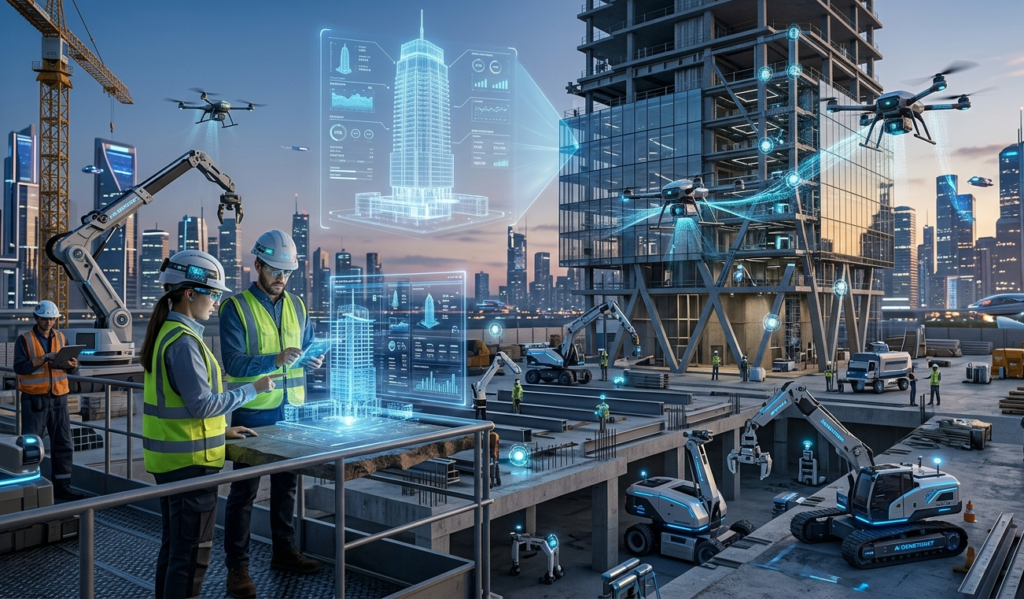
How AI is Transforming BIM
1. Automated Model Checking
AI can analyze BIM models and identify:
- Design inconsistencies
- Code compliance issues
- Missing elements
- Modeling errors
This reduces manual checking time and improves project accuracy.
2. Faster Clash Detection
Traditional clash detection requires engineers to review conflicts manually.
AI-powered systems can:
- Prioritize critical clashes
- Suggest resolutions
- Reduce coordination time
This improves collaboration among project teams.
3. Intelligent Quantity Takeoffs
AI can automatically extract quantities from BIM models and generate reports.
Benefits include:
- Faster estimation
- Reduced human error
- Improved cost control
4. Predictive Construction Planning
AI analyzes historical project data to predict:
- Delays
- Budget overruns
- Resource shortages
- Safety risks
This allows project managers to make proactive decisions.
5. Generative Design
AI can generate multiple design alternatives based on:
- Building requirements
- Cost targets
- Energy efficiency goals
- Site constraints
Engineers can then select the best option for the project.
Tasks AI Can Automate
AI can automate repetitive BIM activities such as:
✅ Family placement
✅ Data validation
✅ Quantity extraction
✅ Clash prioritization
✅ Report generation
✅ Schedule analysis
✅ Model auditing
These tasks save time and improve productivity.
Tasks AI Cannot Fully Replace
Despite its capabilities, AI still cannot replace human expertise in several critical areas.
Engineering Judgment
Construction projects require complex decision-making based on:
- Safety requirements
- Client expectations
- Local regulations
- Site conditions
Human judgment remains irreplaceable.
Client Communication
BIM engineers regularly communicate with:
- Architects
- Contractors
- Consultants
- Project owners
AI cannot effectively manage stakeholder relationships and negotiations.
Creative Problem Solving
Every construction project presents unique challenges.
BIM engineers must:
- Interpret design intent
- Resolve conflicts
- Develop practical solutions
These tasks require creativity and experience.
Coordination Leadership
Successful BIM implementation depends on collaboration between multiple disciplines.
AI can provide recommendations, but human professionals are needed to lead coordination meetings and make final decisions.
How the BIM Engineer Role Will Change By AI
Rather than replacing BIM engineers, AI will create a new generation of BIM professionals.
Future BIM engineers will focus more on:
BIM Strategy
Developing project-wide BIM execution plans and workflows.
Data Management
Managing large datasets generated by smart buildings and digital twins.
AI Integration
Working with AI-powered tools to improve project efficiency.
Digital Twin Technology
Creating intelligent building models connected to real-time operational data.
Advanced Analytics
Using AI insights to support decision-making and project optimization.
Skills BIM Engineers Should Learn for the Future
To stay competitive, BIM professionals should develop skills in:
- Artificial Intelligence fundamentals
- Data analytics
- Python programming
- Machine Learning basics
- BIM automation
- Dynamo scripting
- Digital Twins
- Cloud collaboration platforms
Professionals who combine BIM expertise with AI knowledge will be highly sought after.
Future Outlook
The future of construction is likely to involve a combination of:
- BIM
- AI
- Digital Twins
- IoT (Internet of Things)
- Cloud Collaboration
- Automation
Companies that embrace these technologies will gain a significant competitive advantage.
Rather than eliminating BIM jobs, AI is expected to create new opportunities in:
- BIM Automation
- AI-Assisted Design
- Digital Twin Management
- Construction Data Analytics
- Smart Building Operations
Conclusion
Artificial Intelligence is transforming the BIM industry, but it is unlikely to replace BIM engineers completely. While AI can automate repetitive tasks and improve efficiency, human expertise remains essential for decision-making, coordination, creativity, and project leadership.
The future belongs to BIM professionals who embrace AI as a powerful tool rather than viewing it as a replacement. Engineers who learn AI-driven workflows, automation, and data analytics will be well-positioned for success in the evolving construction industry.
AI will not replace BIM Engineers. However, BIM Engineers who use AI may replace those who do not.
Frequently Asked Questions (FAQs)
1. Can AI create BIM models automatically?
AI can assist in generating BIM models and automating repetitive modeling tasks, but human oversight is still required for accuracy and project-specific requirements.
2. Will BIM jobs disappear because of AI?
No. AI is expected to transform BIM roles rather than eliminate them. Skilled BIM professionals will continue to be in demand.
3. Which BIM software uses AI?
Many modern BIM platforms are integrating AI features, including Revit, Autodesk Construction Cloud, Navisworks, and generative design tools.
4. What skills should BIM engineers learn to work with AI?
Learning Python, Dynamo, data analytics, machine learning basics, and BIM automation can help BIM engineers stay competitive.
5. Is AI useful for clash detection?
Yes. AI can identify, prioritize, and suggest solutions for clashes, helping teams resolve conflicts more efficiently.
6. What is the future of BIM and AI together?
The future includes AI-powered BIM workflows, digital twins, predictive analytics, automated design
Contact Us
Matrix BIM & Design Solutions
📞 Phone: +91 70301 51694
📧 Email: contact@matrix-designs.com